Real answers from someone who has been helping travelers plan Bhutan trips since 2018 — from the India-Bhutan border itself.
How to plan your trip, what to expect from the booking process, and what comes with your package.
We recommend booking at least 4–6 weeks in advance for standard tours. For peak season (March–May, October–December) and festival-timed trips, book 2–3 months ahead. Popular festival dates and premium hotels fill up very quickly. That said, Santosh has pulled together last-minute trips in under a week — so don't assume it's too late without asking.
All our standard packages include:
Not included: International or domestic flights, travel insurance, personal expenses, gratuities for guide/driver, alcoholic beverages.
Yes — every package is a starting point, not a fixed product. Tell Santosh your interests, pace preference, who you're travelling with, and any non-negotiables. He'll build an itinerary shaped entirely around you. We've created custom routes for solo spiritual seekers, multigenerational families with elderly parents, honeymooners, wildlife photographers, and hardcore trekkers. Nothing is off limits if it's possible in Bhutan.
It's simple and human:
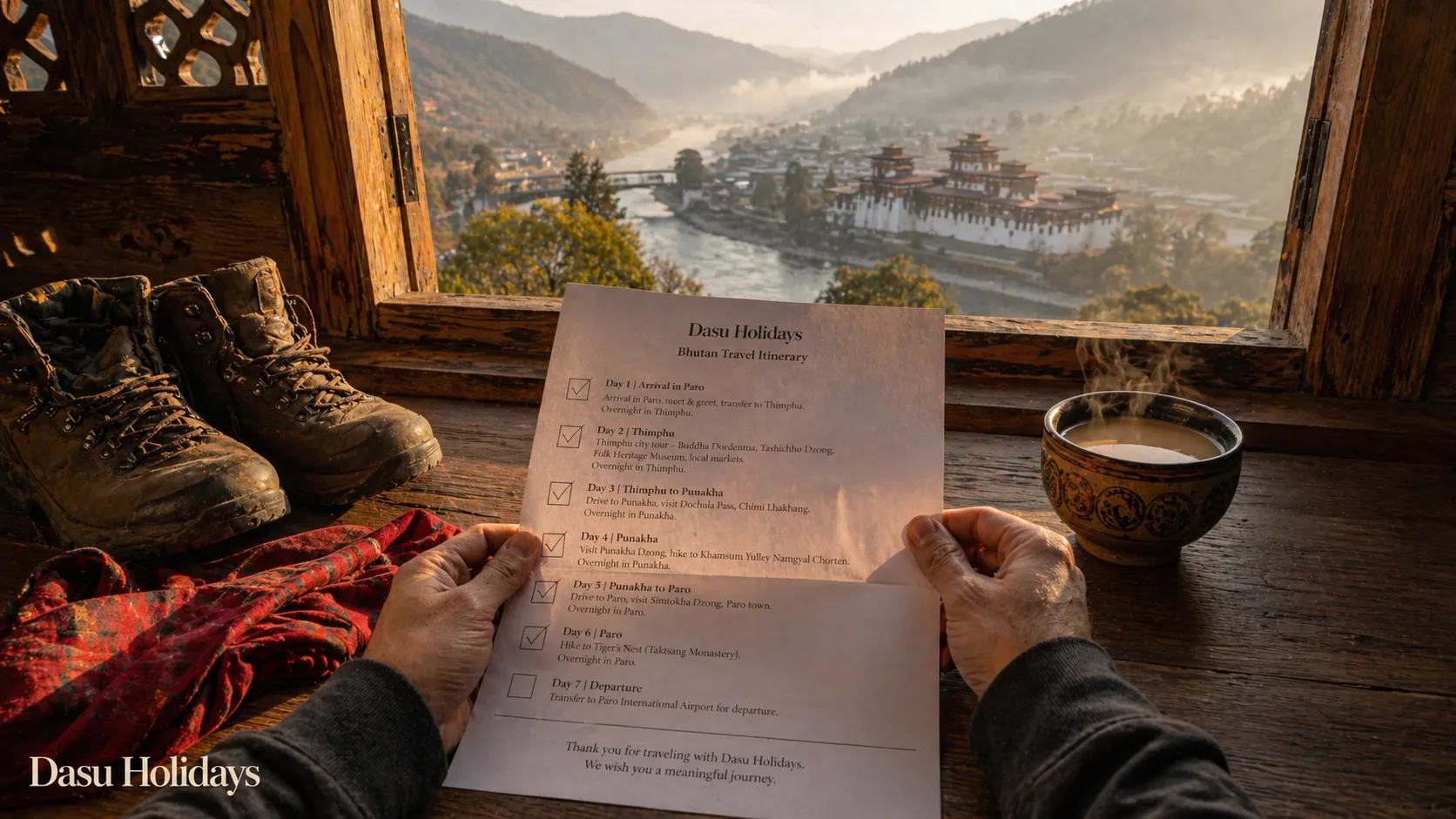
A 7-night (8-day) trip covers the core of Bhutan — Phuentsholing, Thimphu, Punakha, and Paro including Tiger's Nest. This is our most popular length. For trekking, spiritual retreats, or a more relaxed pace: 9–10 nights. For a first taste on a tight schedule: 5–6 nights can work, though you'll feel you left too soon. Santosh's honest advice after hearing your situation is always the most useful guide.
We primarily run private tours — your guide, your vehicle, your itinerary. This is what allows us to tailor every detail. We occasionally put together small group tours (6–10 people) for festival dates and trekking packages where the shared experience adds value. Ask Santosh if there's an upcoming group departure that matches your dates.
Yes. Groups of 6 or more receive preferential rates on accommodation, transport, and guide fees. We regularly handle corporate groups, school and college tours, wedding parties, and family reunion trips. Send Santosh your group size and preferred dates and he'll prepare a group quote within 24 hours.
Everything about entry requirements, the Sustainable Development Fee, and permits — for both Indian and international travelers.
No — Indian citizens do not need a visa for Bhutan. You need a valid Indian passport (or voter ID card with photo). However, since 2023, Indian nationals must pay the Sustainable Development Fee (SDF) of ₹1,200 per person per night. Santosh handles all permit processing and documentation on your behalf.
The Sustainable Development Fee (SDF) is a tourism levy paid by all tourists visiting Bhutan:
The SDF funds Bhutan's free healthcare, education, and environmental conservation. It also keeps Bhutan deliberately uncrowded — you get a country that feels almost entirely to yourself. We believe it's the best money spent in any travel budget.
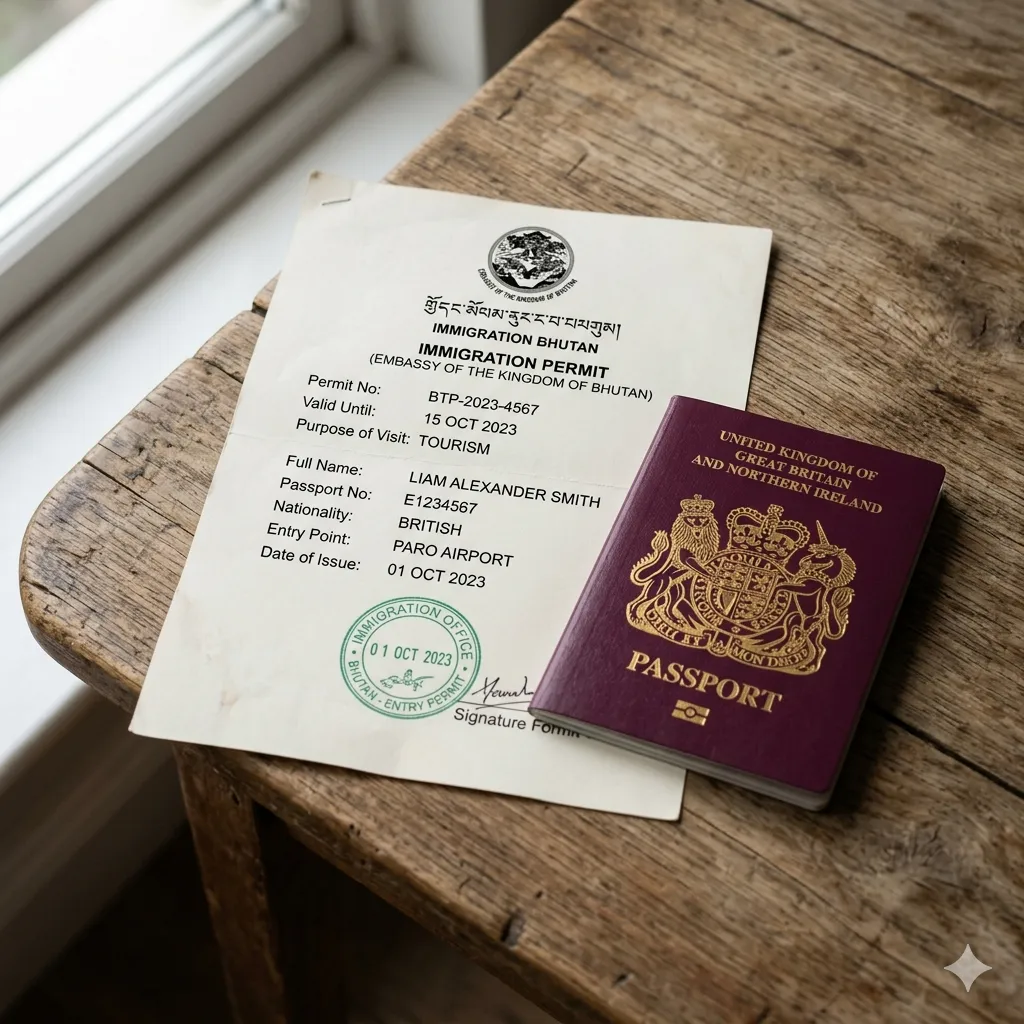
Yes. All non-Indian, non-SAARC tourists need a Bhutan visa issued through an authorised Bhutanese tour operator (like us). The visa fee is USD $40 per person. We handle the entire visa application and receive the visa clearance letter on your behalf — you collect the visa stamp at Paro Airport on arrival. Processing takes 3–7 working days.
For international tourists: the visa clearance letter typically takes 3–5 working days once we submit your passport details to the TCB. Peak season (March–May, October–December) can take up to 7 days. We recommend booking at least 3 weeks before travel to allow comfortable processing time.
For Indian tourists: permit processing at the Phuentsholing border or Paro Airport is faster — typically same-day for border crossings if you arrive before noon. Santosh pre-coordinates your documents to ensure smooth passage.
For international tourists (non-Indian, non-SAARC): No. Bhutanese law requires all international visitors to book through a licensed tour operator. The visa is issued through the operator and cannot be obtained independently.
For Indian tourists: technically yes, you can travel without a formal operator. However, you'll need to handle SDF payment, permits, and all bookings yourself — and you'll miss local knowledge, restricted-area permits, and the support network that makes Bhutan magical rather than stressful.
Yes. Several areas in Bhutan require Restricted Area Permits (RAP) in addition to the standard visa:
As a TCB-authorised operator, we can apply for these permits on your behalf. Not all operators can do this — it's one of the advantages of working with us. Cost varies by area; Santosh will inform you at the quotation stage.
Here's the clear breakdown:
So Indian travelers pay significantly less SDF than international visitors. This is one reason our India Special Package offers excellent value — the SDF alone saves Indian travelers thousands of rupees compared to international rates.
Yes. Children under 5 years are exempt from the SDF entirely. Children aged 5–12 pay 50% of the adult SDF rate. This can make a significant difference for family trips — we calculate this accurately in your quote and pass on the full saving to you.
What a Bhutan trip actually costs — broken down transparently, with no hidden charges.
Our package prices:
These prices include accommodation, all meals, TCB-certified guide, transport within Bhutan, monument fees, and SDF processing. Flights and travel insurance are extra. We provide a fully itemised quote — SDF, visa, hotel cost, guide, transport — all broken down so you know exactly where every rupee goes.
None. Ever. This is our core commitment. When Santosh quotes you a price, that's the price you pay — not a rupee more. Everything is disclosed upfront: the SDF amount (calculated per person per night), visa fees, accommodation grade, transport type, guide cost, and all monument entry fees. There are no commission-based shopping stops, no "tips are mandatory," no surprises on the last day.
The SDF funds Bhutan's free healthcare, free education, and environmental protection. In practical terms, it ensures Bhutan stays uncrowded — you're not fighting for space at Tiger's Nest with 5,000 others. You're there with perhaps 20 people. It means your guide has time for you. It means the monasteries feel sacred rather than commercialised.
Most travelers who worry about the SDF before they go call it the best money they spent on the trip after they return.
Beyond the package price, budget for:
For international tourists: yes, Bhutan is more expensive than Nepal or India primarily because of the SDF. A 7-night trip for an international traveler costs approximately $1,350–$2,100 per person all-in (including SDF but excluding flights).
For Indian travelers: Bhutan is very competitively priced — especially with the lower SDF rate. Many Indians find Bhutan costs less than a comparable premium trip to Rajasthan or Kerala when quality of experience is factored in.
The higher base price for international visitors buys something genuinely rare: a country that hasn't sold its soul to mass tourism.
Yes. Our standard structure is 25% deposit at booking, 75% balance 30 days before departure. For large groups or luxury bookings, Santosh can discuss a custom payment schedule — just ask. We accept bank transfer (NEFT/RTGS/IMPS), UPI, international wire (SWIFT), and card payments via secure gateway.
A rough breakdown for two international travelers, 7 nights:
For Indian nationals, the same trip in our India Special / Cultural package would cost approximately ₹1.3–1.6 lakhs for two, including SDF at ₹1,200/night rate.
The best times to visit Bhutan for clear skies, festivals, trekking, and value — season by season.
Bhutan is beautiful year-round but the two ideal windows are:
Santosh can match your specific dates to upcoming festivals and give you the most honest assessment of what conditions to expect when you arrive.
Yes, especially for Indian travelers. Winter benefits:
Drawbacks: cold nights (Thimphu can hit -5°C), higher passes may be snowed in, some trekking routes inaccessible. Pack thermal layers.
Bhutan's monsoon is gentler than India's — the Himalayan terrain means rain typically comes in the late afternoon and evening. Mornings are often clear. The landscape turns lush and dramatically green.
Challenges: mountain roads can be slippery and occasionally blocked by landslides; trekking is muddy; mountain views are often obscured by cloud. Not impossible — but you need flexibility and realistic expectations. Santosh will never oversell monsoon travel — he'll tell you exactly what to expect.
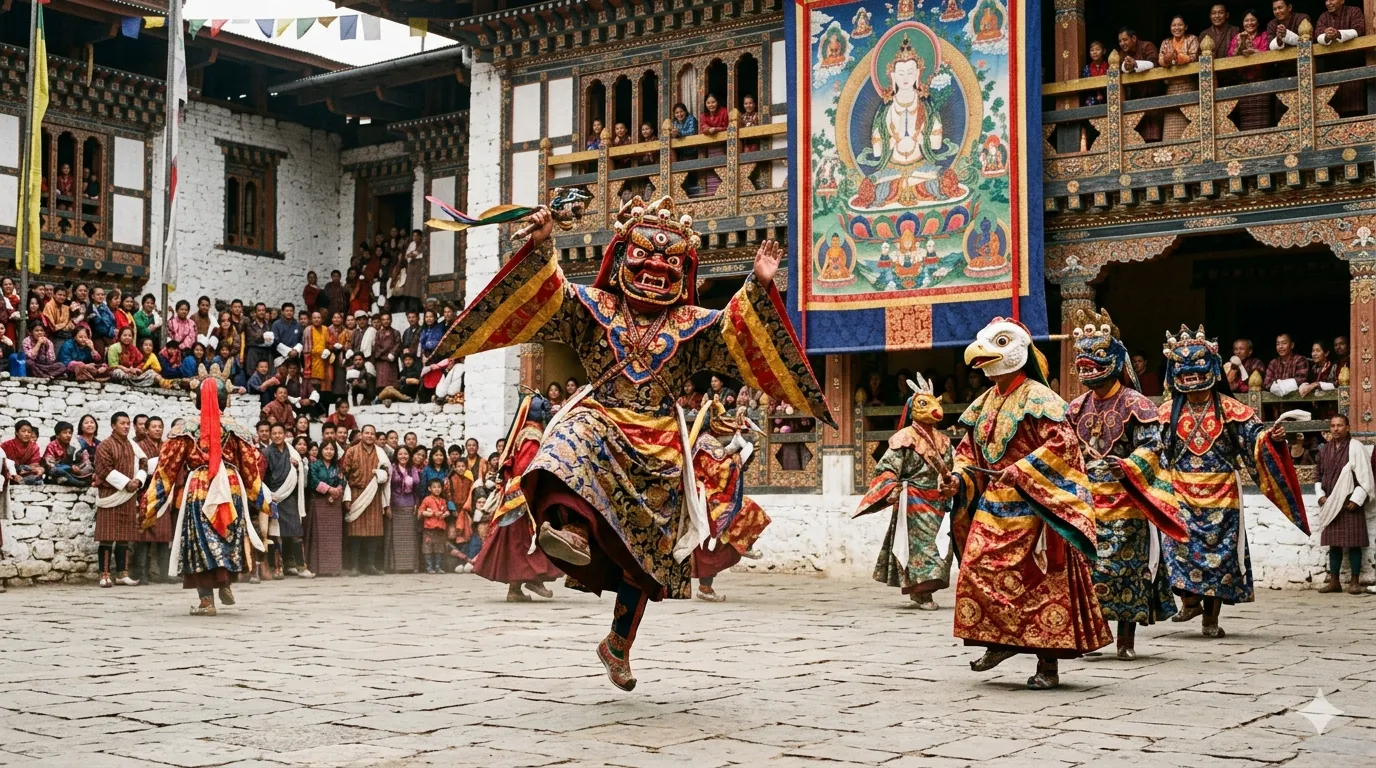
Tsechus are the sacred masked dance festivals unique to Bhutan. Key ones:
Festival dates follow the Bhutanese lunar calendar and change annually. Santosh confirms exact dates for your travel year at booking.
The hike is best in Spring (March–May) and Autumn (September–November) — weather is stable, views are clear, and the trail isn't slippery from rain or ice. In winter, the monastery exterior can be snow-dusted and hauntingly beautiful, but the climb requires good footwear. Avoid monsoon for this hike if you can.
We book the hike for mid-morning starts — you arrive before the midday tour groups and catch the monastery in the best light.
Yes — late September/early October and late February/early March are the sweet spots: post-monsoon clarity in autumn, and pre-spring bloom in late winter. Fewer crowds than peak weeks, but still good weather. Santosh often recommends these windows to travelers who want the best of both worlds. Just avoid major festival dates if you prefer uncrowded sites.
How to reach Bhutan — by air, by road, from India and beyond.
There are two main ways:
Paro Airport is famously challenging — only specially trained pilots can land there. Expect a dramatic mountain approach with steep valley walls on both sides and a sharp descent. If it's clear, you'll see the Himalayas from the window. Most travelers describe the landing as both terrifying and exhilarating. On arrival, your guide will meet you at the exit gate with a traditional khata (white welcome scarf) and a sign with your name.
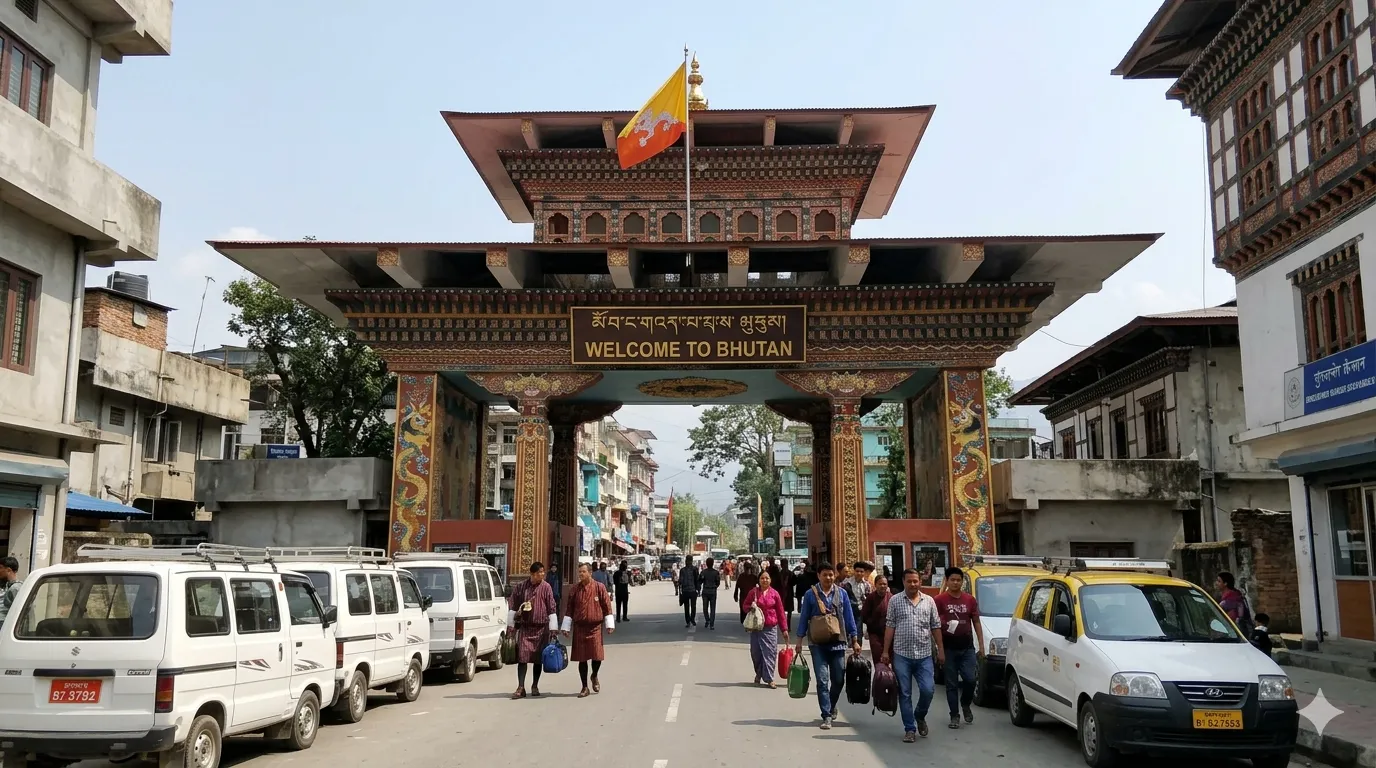
Yes — the main land border is at Phuentsholing, accessible via Jaigaon, West Bengal (where our office is). You can drive from Indian metros (Delhi ~2.5 days, Kolkata ~12–14 hours) or hire a vehicle. From Phuentsholing, the drive to Thimphu is approximately 6 hours through mountain switchbacks. Other land borders exist at Gelephu and Samdrup Jongkhar (south/east) but are less commonly used.
The closest Indian airport to the Bhutan land border is Bagdogra (IXB) in West Bengal — about 170 km from Phuentsholing. Many international travelers fly to Bagdogra and drive to Bhutan via Jaigaon. Other options:
Your guide will meet you at the immigration exit of Paro International Airport, holding a sign with your name and a traditional khata (white welcome scarf). For land-border travelers, your guide meets you at the immigration office in Phuentsholing. Santosh shares your guide's name, phone number, and photo 48 hours before arrival — no confusion, no anxiety at the border.
What it's actually like once you arrive — safety, language, food, internet, and altitude.
Bhutan is one of the safest tourist destinations in the world. Crime rates are extremely low. The country is politically stable, the local population is famously welcoming, and policing is gentle but effective. Solo female travelers consistently report feeling completely safe. The main travel risks are altitude (most cities sit at 2,200–3,100m), mountain road conditions in monsoon, and weather-related flight delays — none of which are crime-related.
For most travelers on our standard cultural and family packages, no — altitude is not a serious concern. Paro (2,200m) and Thimphu (2,334m) are at moderate altitudes that healthy adults adjust to within 24 hours. Higher experiences include Dochula Pass (3,100m) and Tiger's Nest (3,120m at the top). For our Druk Path Trek, altitudes reach 4,110m — more significant preparation needed.
If you have heart or lung conditions, tell us at booking. We can adjust the itinerary to keep you in the lower valleys (Punakha is at just 1,300m).
The official language is Dzongkha, but English is widely spoken — it's the language of education from primary school. All hotel staff, our guides, and most shopkeepers in tourist areas speak fluent English. Guides are also fluent in Hindi (essential for Indian travelers). French, German, Japanese, and Mandarin-speaking guides are available on request for premium packages.
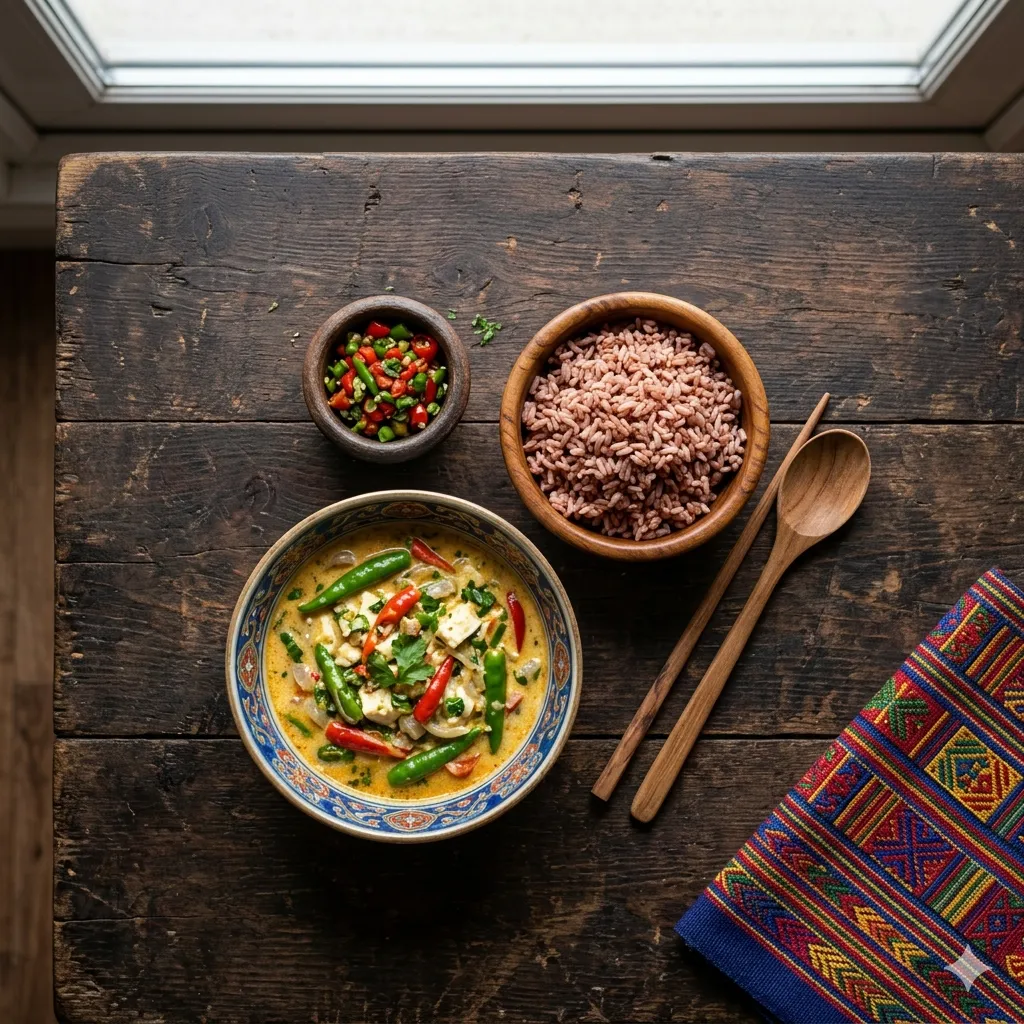
Bhutanese food is robust mountain cooking — heavy on chillies, cheese, and red rice. Must-try dishes: ema datshi (chilli cheese stew, the national dish), kewa datshi (potato cheese), shamu datshi (mushroom cheese), jasha maru (chicken stew).
Vegetarians: Easy — almost every dish has a vegetarian version. Indian travelers will find dal, sabzi, and roti readily available. Jain travelers: Possible with 48+ hours advance notice. Allergies: Tell us at booking — Bhutanese cooks are accommodating.
Yes, in cities. Bhutan has reliable 4G in Paro, Thimphu, and Punakha. All hotels offer free WiFi. Guides carry mobile hotspots. Coverage drops at mountain passes, trekking routes, and remote valleys — which most guests find refreshingly liberating. A local SIM (B-Mobile or TashiCell, ~$5 at airport) gives you data throughout. Indian Airtel/Jio networks generally work in major cities.
Bhutan uses the Ngultrum (BTN), pegged 1:1 with the Indian Rupee. Indian Rupees are accepted everywhere except ₹500 and ₹2,000 notes (use ₹100 and ₹200 notes). Cash is preferred for souvenirs, street food, tea houses, and tips. Card payments work at hotels and larger restaurants. ATMs are limited to Thimphu and Paro. Carry approximately $200–300 (or equivalent) in small denominations for personal expenses.
Exceptionally safe. We regularly arrange solo trips for women. Bhutan has one of the lowest crime rates in Asia and the local culture is genuinely respectful. Female guides are available on request. Our guides are TCB-certified, English-speaking, and grew up in the region. Santosh is reachable on WhatsApp 24/7 throughout your trip.
Why book with a small operator and what makes us different.
Within 24 hours on weekdays, often the same day. For urgent queries, WhatsApp — Santosh typically replies within the hour during office hours (Mon–Sat, 9am–7pm IST). You're not getting a template auto-reply or a junior salesperson. Every enquiry comes directly to Santosh and his reply is written personally based on what you've shared.
Absolutely. Zero cost, zero obligation. Santosh will answer every question honestly — even if the answer is "you don't need to book through us for that." Trust is earned before money is taken. Many travelers spend weeks asking questions before they're ready to commit. That's completely normal and we're patient.
Six honest reasons:
Yes. DMC BHUTAN TRIP is a Tourism Council of Bhutan (TCB) authorised handling agent — required for all foreign tourist visas and SDF processing. Our guides are also TCB-certified, which is mandatory for guiding tourists in Bhutan. We are a registered Indian tour operator with valid GST registration, based in Jaigaon, West Bengal. We'll share our credentials on request.
Yes — many of our family groups include elderly parents. Santosh designs itineraries around actual pace and comfort, choosing hotels at the right altitude with elevators. For limited mobility: most dzong visits have alternative routes, Tiger's Nest can be partially done by mule, and ground transport is private and door-to-door. Tell us specific needs at enquiry stage and we'll plan accordingly.
Yes — 24/7 WhatsApp support from the moment you land in Paro until you leave. Santosh is reachable for any issue and most problems can be resolved within hours by a phone call to your guide or hotel. For emergencies (medical, weather), Santosh has direct relationships with hospitals, embassies, and airlines from years of working in the region.
Packing, electricity, photos, etiquette — the small but important details.
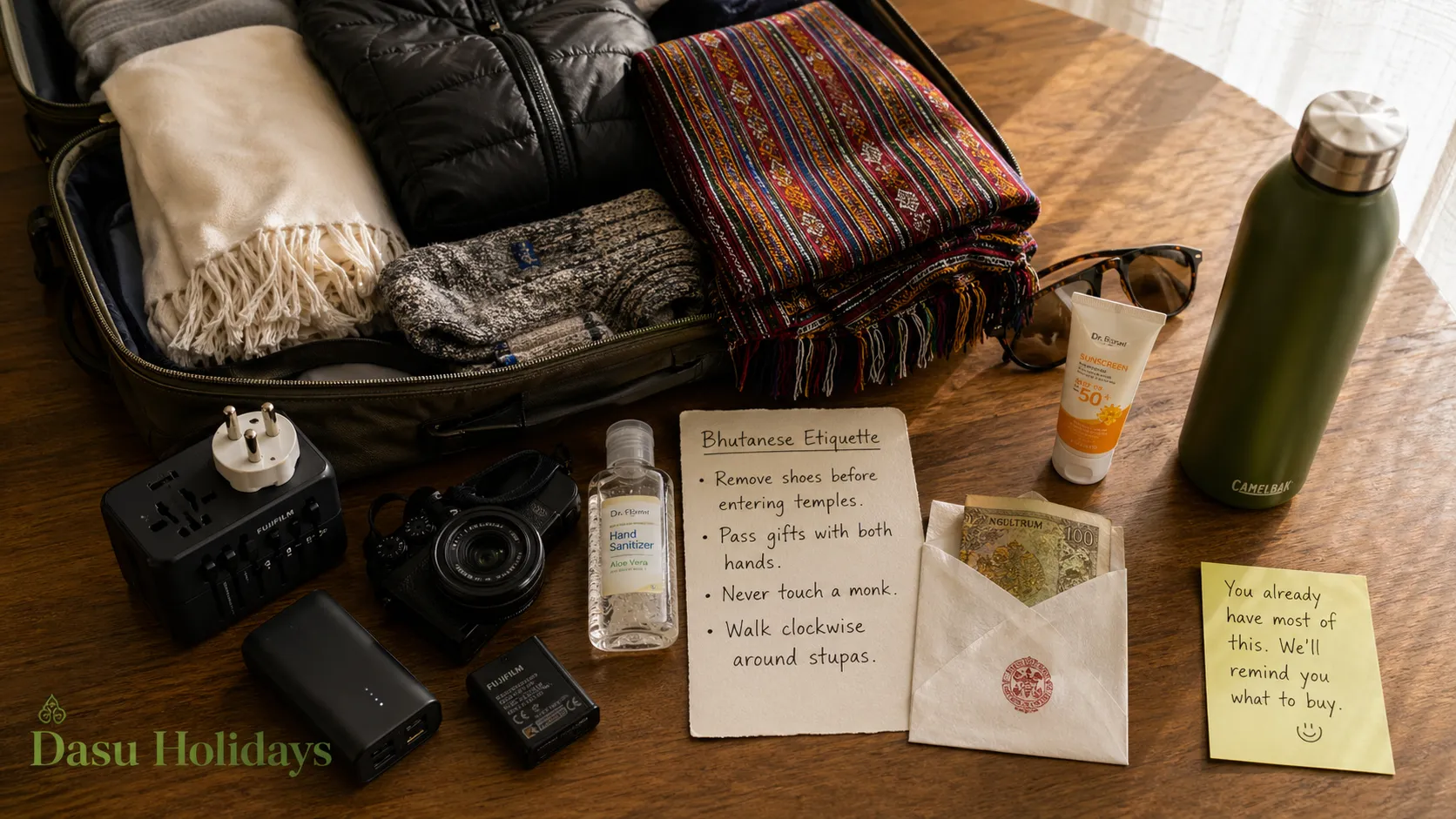
Essentials:
Winter (Nov–Feb): Add thermals, gloves, warm hat. Monsoon (Jun–Aug): Add rain jacket and quick-dry clothing.
Bhutan is deeply Buddhist and traditional. Your guide will brief you, but the basics:
Yes, but with rules:
Bhutan uses Type C, D, F, G, and M plugs — the same range as India, with 230V/50Hz. Indian and European chargers work without adapters. American/Canadian travelers need a universal adapter. All quality hotels have backup generators. Carry a power bank if you'll be off-grid.
Tipping is not mandatory but is appreciated. Reasonable amounts (entirely discretionary):
Tip on the last day in cash (USD or Indian Rupees both accepted) in an envelope if possible. No obligation to tip if service wasn't excellent.
Bhutan has limited but functional medical infrastructure. Major hospitals are in Thimphu and Paro. For serious emergencies:
This is why we strongly recommend comprehensive travel insurance with medical evacuation cover — it's the single most important non-trip expense.
Tap water is generally not safe for tourists. We provide unlimited bottled water in your vehicle and at meals. All hotels offer filtered or bottled water in rooms. If you want to reduce plastic, bring a refillable bottle with a built-in filter — many hotels have water refill stations as part of Bhutan's plastic reduction efforts.
Try a different search term or message Santosh directly — he's happy to answer anything.
WhatsApp SantoshSantosh personally answers every enquiry within 24 hours. Free consultation, no commitment, no pressure.